
Accounts Payable Workflow Automation: How Temporal Improves Reliability in Fintech


OCR is not the hard part of the accounts payable automation workflow. The hard part is reliable coordination across approvals, exception queues, ERP syncs, payment rails, and audit trails. In fintech, every handoff is a failure boundary, and every retry can become a money problem.
Temporal is built for this class of workflow: durable executions that preserve Event History, recover after crashes, and continue running for years if needed. That makes it a strong fit for invoice-to-payment orchestration where correctness matters as much as speed.
What is AP Workflow Automation — and Where Does it Break?
AP workflow automation is the use of technology to handle the full invoice-to-payment lifecycle — capture, validation, coding, approvals, payment execution, and reconciliation — as one connected, auditable process rather than a sequence of manual handoffs.
In practice, most teams have some automation. They may use OCR to ingest invoices, or a tool to route approvals via email. The problem is that these steps are often stitched together loosely: cron jobs that call external APIs, approval state stored in spreadsheets, payment triggers that rely on someone remembering to run a script.
When volume increases, these brittle connections break — and they break silently. An approval gets stuck. A payment run fires twice. A reconciliation mismatch sits undetected until month-end close.
Key insightThe core problem in AP automation isn’t missing technology — it’s missing durability. Workflows fail not because the business logic is wrong, but because the execution infrastructure doesn’t survive retries, timeouts, or partial failures. |
How Temporal Solves Accounts Payable Workflow Automation Failures
Temporal is well suited to AP automation because it handles long-running, failure-prone workflows without forcing teams to stitch together state tracking, retries, and recovery logic by hand. In invoice-to-payment operations, that matters because approvals can take days, payment APIs can fail intermittently, and exceptions often need manual review before processing can continue.
For fintech AP teams, Temporal helps in a few practical ways:
- Approvals stay on track: long waits for approvers, finance leads, or compliance reviewers do not break the workflow.
- Failures are easier to recover from: external calls to ERP systems, OCR services, or payment processors can be retried without rebuilding orchestration logic.
- Workflow state stays visible: teams can see whether an invoice is awaiting approval, blocked by an exception, or moving toward payment.
- Human review is built into the process: approvals, escalations, and exception handling can be modeled directly instead of bolted on through email threads or side systems.
- Changes can be rolled out safely: teams can evolve workflow logic without disrupting invoices already in flight.
That combination makes Temporal a strong foundation for AP automation in fintech, where process reliability matters as much as throughput.
Common AP Bottlenecks and How Temporal Resolves Them
| AP Bottleneck | Root Cause | Temporal-Based Resolution |
| Stuck approvals | No durable state; emails get missed or ignored | Timer-triggered escalations + signal-based approval gates |
| Duplicate payments | No idempotency across retried payment runs | Workflow IDs enforce exactly-once payment execution |
| Failed API calls to payment processors | No retry logic; failures surface as data gaps | Activity-level retries with exponential backoff |
| Unresolved exceptions blocking reconciliation | Exception state stored outside the workflow | Exception sub-workflows with SLA-bound resolution timers |
| No audit trail for approvals | State lives in email threads, not systems of record | Every signal and state transition is persisted in Temporal’s event history |
| Multi-entity reconciliation failures | Entity-specific logic hardcoded; breaks with new subsidiaries | Parameterized child workflows per entity, orchestrated from a parent |
| Want the architecture behind this approach?
Read Xgrid’s Building Enterprise-Grade Workflows with Temporal guide and the Temporal Observability in Production whitepaper. Those resources are explicitly positioned around visibility, versioning, replay-safe debugging, and detecting stuck RUNNING workflows—the same production concerns that decide whether an AP automation workflow remains reliable at scale. |
How to Design a Durable Invoice-to-Payment Workflow with Temporal
A well-designed Temporal-based AP workflow should treat the invoice lifecycle as one orchestrated process, from intake to reconciliation. Each stage can be modeled clearly so failures, approvals, and exceptions are handled in the workflow itself rather than scattered across separate systems.
- Invoice intake and capture: An activity calls your OCR or extraction service and returns structured invoice data such as vendor, amount, PO reference, and coding fields.
- Validation and 3-way matching: Activities or child workflows compare invoice data with purchase orders and goods receipts. If mismatches appear, the workflow routes the invoice into an exception path for review.
- Coding and ERP write-back: GL coding rules are applied, and the ERP is updated through dedicated activities. This keeps system updates isolated and easier to manage when external dependencies fail.
- Multi-level approvals: Approval steps are modeled directly in the workflow, with notifications, approval responses, and escalation paths tied to business rules and SLAs.
- Payment execution: Once approvals and validations are complete, a payment activity triggers the processor or rail. This step should be designed to prevent duplicate execution.
- Reconciliation: After payment, a final step checks the transaction against the ERP record and invoice status. Any mismatch opens a follow-up exception path; successful runs close with a complete process record.
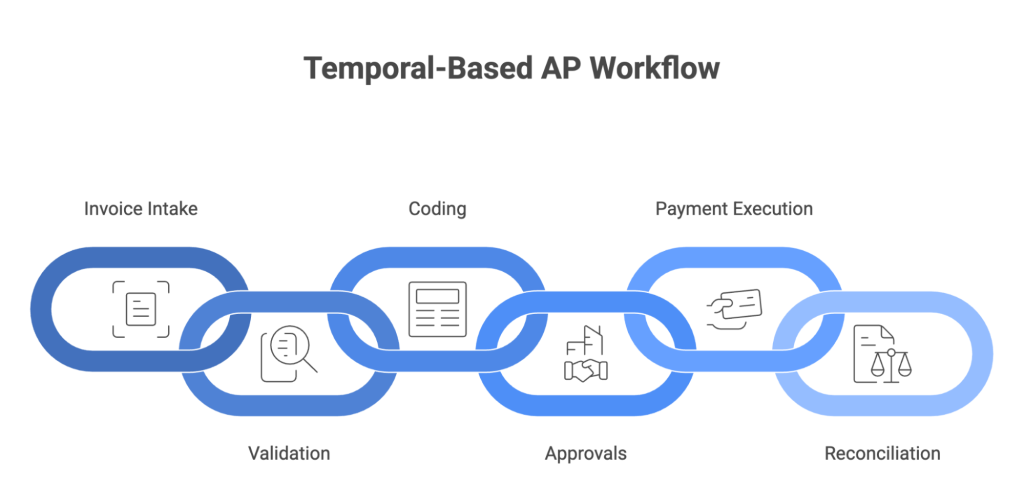
Diagram of a Temporal-based accounts payable workflow: invoice intake, validation, coding, approvals, payment execution, and reconciliation.
This structure gives AP teams a workflow that is easier to operate, monitor, and extend as entities, currencies, and approval layers grow more complex.
Best Practices for AP Automation Process Flow in Fintech
Standardize Intake Before Automating Anything Downstream
Automation amplifies what’s already there. If invoice intake is inconsistent — PDFs, scanned images, email bodies — variance in incoming data propagates into every downstream step. Use OCR with structured field validation as the first activity in your workflow. Reject or flag invoices that fail field requirements before they enter the approval queue.
Build Exception Handling as First-Class Workflows, Not Afterthoughts
Exceptions — duplicate invoices, missing PO references, mismatched amounts — are not edge cases. In high-volume AP, they’re predictable. Design dedicated exception sub-workflows with clear ownership routing, SLA timers, and documented resolution paths. Don’t let exceptions block the main workflow; run them in parallel with payment holds.
Use Approval Matrices That Mirror Your Actual Org Structure
Approval bottlenecks usually aren’t technical — they’re structural. Routing rules that don’t match how authority is actually delegated result in invoices landing in the wrong queue, or no queue at all. Map your real approval thresholds, department hierarchies, and entity structures into your workflow configuration. Temporal’s signal model makes it straightforward to implement conditional routing without hardcoding.
Instrument Everything for Observability
A durable workflow is only as useful as your ability to see inside it. Temporal’s Web UI provides real-time workflow state, event history, and activity timelines out of the box. Supplement this with metrics on approval latency, exception rates, and payment cycle times. This data is your lever for continuous optimization — you can’t improve what you can’t measure.
Design for Multi-Entity and Multi-Currency From Day One
In fintech, entity sprawl is the norm, not the exception. A workflow designed for a single subsidiary will need costly rework when you add subsidiaries or expand internationally. Use parameterized child workflows that accept entity-specific routing, currency handling, and compliance rules — so adding a new entity is configuration, not code change.
Production Readiness Checklist for Accounts Payable Workflows with Temporal
Before shipping a Temporal-based AP automation workflow, confirm:
- Invoice intake validates required fields before downstream processing begins
- OCR and extraction failures route to a durable exception workflow
- Approval steps use Temporal signals instead of email-only or spreadsheet-based state
- Approval escalations use timers with clear SLA thresholds
- ERP write-back runs as an idempotent activity
- Workflow versioning is planned for invoices that remain in flight during process changes
When to Re-Evaluate Your Current AP Workflow Infrastructure
Not every team needs to rebuild from scratch. But there are clear signals that your current AP automation process flow has structural limits that won’t be solved by adding another integration:
- Payment runs are producing duplicates or missed payments despite existing controls
- Approval state lives in email or spreadsheets rather than your system of record
- Exception resolution is manual and undocumented, creating audit risk
- Adding a new entity or currency requires code changes rather than configuration
- Your team has no visibility into in-flight workflow state without querying multiple systems
- Infrastructure failures cause silent workflow drops rather than automatic retries
If three or more of these are true, the bottleneck is likely your workflow execution layer — and Temporal is the right starting point for the conversation.
Conclusion: Optimize the Workflow, Not Just the Invoice Scanner
The biggest mistake in AP automation is treating the problem as document capture plus approval routing. In fintech, the real problem is durable orchestration across long waits, compliance checks, external payment systems, partial failures, and audit-heavy outcomes.
Temporal gives you the primitives to build that correctly: durable workflows, signals, timers, activities, visibility, versioning, and lifecycle controls like Continue-As-New. Used well, those primitives turn the accounts payable automation workflow from a fragile chain of services into a resilient, inspectable system of record for invoice-to-payment execution.
Xgrid helps teams design, ship, and stabilize production-grade Temporal workflows through Forward-Deployed Engineers who embed for 2–6 weeks, and Xgrid offers a free workflow review as well.
Frequently Asked Questions About AP Workflow Automation with Temporal
What is accounts payable workflow automation?
Accounts payable workflow automation coordinates the full invoice-to-payment lifecycle, including capture, validation, approvals, payment execution, and reconciliation.
In fintech, the goal is not only faster processing but also reliable state, auditability, and safe recovery across every handoff.
Why use Temporal for AP automation?
Temporal helps AP workflows survive long waits, failed API calls, approval delays, retries, and payment-state recovery.
It preserves workflow history and execution state so teams can inspect, retry, resume, or escalate invoice workflows without rebuilding orchestration logic.
How does Temporal prevent duplicate payments in AP workflows?
Temporal supports durable workflow IDs, activity retries, and idempotent payment execution patterns.
When payment activities use stable idempotency keys, a retry or worker crash does not create a second payment for the same invoice.
What should fintech teams monitor in AP automation workflows?
Teams should monitor approval latency, stuck invoices, exception queues, retry spikes, payment failures, and reconciliation mismatches.
Search Attributes and Temporal Event History make it easier to trace invoice status, ownership, and failure points across the full workflow.
If your AP automation workflow already exists but feels brittle around approvals, retries, observability, or payment-state recovery, book the free workflow review and use it as an AP automation audit: map the entities, find the hidden failure boundaries, and fix them before they become money-moving incidents.
Related Temporal Fintech and Workflow Reliability Guides
- For durable payment orchestration, saga patterns, and audit-ready fintech workflows, read: Design Durable And Long-Running Fintech Workflows on Temporal From Day One
- For charge, ledger, and reconciliation failure handling, read: How to Handle Partial Failures in Payment Systems
- For retry behavior, dependency outages, and cost control, read: Temporal Retry Policies at Scale
- For stuck workflows, Search Attributes, heartbeat payloads, and production visibility, read: Temporal Observability in Production Guide
Related Articles
Related Articles

Established in 2012, Xgrid has a history of delivering a wide range of intelligent and secure cloud infrastructure, user interface and user experience solutions. Our strength lies in our team and its ability to deliver end-to-end solutions using cutting edge technologies.
NAVIGATE
Cloud & DevOps Web & Mobile Apps Temporal Digital Marketing GTM Engineering Marketo Consulting HubSpot Consulting Company Careers ResourcesOFFICE ADDRESS
US Address:
Plug and Play Tech Center, 440 N Wolfe Rd, Sunnyvale, CA 94085
Dubai Address:
Dubai Silicon Oasis, DDP, Building A1, Dubai, United Arab Emirates
Pakistan Address:
Xgrid Solutions (Private) Limited, Bldg 96, GCC-11, Civic Center, Gulberg Greens, Islamabad
Xgrid Solutions (Pvt) Ltd, Daftarkhwan (One), Building #254/1, Sector G, Phase 5, DHA, Lahore
Xgrid © 2026. All rights reserved.