
Agentic Engineering: Building Production-Ready AI Agents


AI assistants have changed how engineers research problems, write code and interpret documentation. But generating a useful answer or code snippet is not the same as completing engineering work safely.
Production environments require agents that can understand the current state of a system, plan a sequence of actions, use approved tools, make controlled changes and verify the result. Building those capabilities is the domain of agentic engineering.
Agentic engineering is the practice of designing AI agents to perform multi-step engineering work through governed tools, live system context, explicit controls and outcome-based validation. It moves AI beyond suggestions and embeds it into repeatable operational workflows.
The distinction matters. An assistant can recommend which Kubernetes add-on to upgrade. A production-grade engineering agent must determine what is installed, assess compatibility, identify affected configurations, prepare the correct changes, request approvals and prove that the upgraded component works.
Agentic Engineering vs AI Assistants
AI assistants generally work within a limited interaction: a person provides a prompt, the model generates a response and the person decides what to do next. They can accelerate individual tasks, but the engineer remains responsible for carrying context and coordinating the complete process.
Agentic systems operate differently. Anthropic distinguishes agents from predefined AI workflows by describing agents as systems in which the model dynamically directs its own processes and tool use. That autonomy is valuable, but it also requires stronger controls once an agent can affect real systems.
| Capability | AI assistant | Agentic engineering system |
| Primary output | Answer, recommendation or code | Completed engineering outcome |
| Context | Prompt and attached files | Live systems, repositories and curated knowledge |
| Execution | Engineer performs the work | Agent acts through approved tools |
| Instructions | Individual prompts | Versioned and reusable skills |
| Permissions | User’s existing access | Explicit tool and capability boundaries |
| Validation | Engineer checks the response | Automated and human validation gates |
| Auditability | Conversation history | Skill versions, actions, approvals and results |
| Completion | Response generated | Intended outcome verified |
The shift is not simply about giving an LLM more autonomy. It is about engineering the environment around the model so its work is controlled, observable and repeatable.
Why AI Agents Fail in Production
A capable model does not automatically create a reliable engineering agent. Most failures occur because the surrounding system is missing the context, controls or verification needed for production work.
Stale System Context
Infrastructure changes constantly. A repository may show the desired configuration while the runtime environment contains different versions, manually applied resources or configuration drift.
An agent working only from Git or an internal wiki can produce a technically reasonable plan for a system that no longer exists. Production agents need access to current, authoritative state.
Unstructured Instructions
One-off prompts depend heavily on how an individual engineer describes the task. Two engineers can ask for the same outcome and receive materially different plans.
Prompts are useful for exploration, but repeatable engineering work requires instructions that can be versioned, reviewed, tested and improved.
Excessive Tool Access
An agent connected to unrestricted APIs or shell commands may be able to perform the requested task, but it can also act outside the intended boundary.
Tool access must be scoped by task and environment. The Model Context Protocol provides a standard architecture for connecting AI applications to external tools and data, but safe implementation still requires authorization, validation and user control around those capabilities.
Weak Completion Criteria
An agent may update a version number and report success without identifying other affected files, handling breaking changes or validating the deployed system.
For production work, “the agent completed its response” and “the engineering task succeeded” are entirely different conditions.
Missing Human Control
Not every decision should be automated. Permissions, breaking changes, uncertain recommendations and production progression may require expert judgment.
Human-in-the-loop AI should be part of the workflow architecture, with approval points triggered by risk and uncertainty—not added as a generic review step after everything has already happened.
Core Requirements for Production-Ready Agentic Systems
Moving from an AI assistant to an engineering agent requires more than adding tools to an LLM. The surrounding system must provide reliable context, controlled execution and an objective way to determine whether the work succeeded.
A production agentic engineering workflow should include:
- Current system state: Agents need authoritative information about the environment they are working on.
- Relevant domain knowledge: Release notes, compatibility rules, policies and internal standards must remain current and traceable.
- Task-specific context: Agents should receive the files and evidence required for the task rather than unrestricted access to every available source.
- Governed execution: Tools, permissions and high-risk actions must be constrained by explicit policies and approval gates.
- Outcome validation: Completion should depend on functional evidence, not whether the agent generated a response or executed a command.
These requirements can be organized into a six-layer agentic AI architecture covering observation, knowledge, assessment, context, execution and validation.
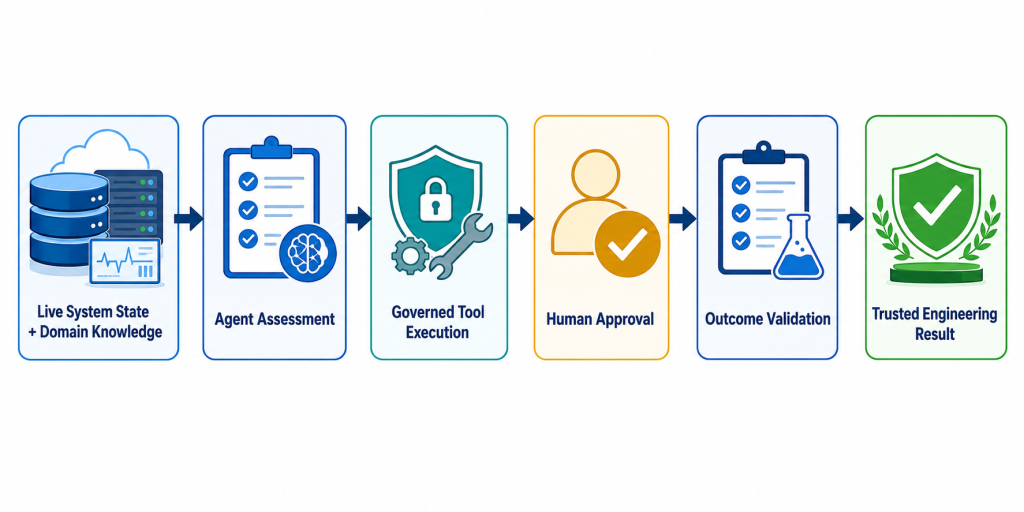
If your engineering team is already experimenting with agents but still depends on manually assembled context, unrestricted tools or informal validation, Xgrid can help turn that prototype into a governed agentic workflow with defined controls and production-readiness gates.
Completion Gates for Reliable Agent Workflows
Partial execution is one of the most dangerous failure modes in agentic engineering because the output may look convincing even when necessary actions were missed.
Consider an agent asked to upgrade an infrastructure component. It may correctly modify the primary configuration but fail to:
- Update associated CRDs
- Modify a second deployment pattern
- Account for an application dependency
- Execute a migration step
- Validate every affected environment
A completeness gate prevents the agent from reporting success until every identified action has been resolved. Each action must be completed, explicitly skipped with a reason or escalated for review.
The implementation described here enforced a 100% action-completeness requirement for infrastructure changes. This did not mean that every change had to be executed automatically. It meant the agent could not silently ignore an action and still claim that the task was finished.
That distinction is essential for any governed AI agent performing high-impact engineering work.
Human-in-the-Loop Governance for AI Agents
Human-in-the-loop design should concentrate expert attention where judgment has the greatest value.
| Decision point | Agent responsibility | Human responsibility |
| Initial assessment | Collect data and generate options | Select the work to proceed with |
| Compatibility analysis | Map evidence and flag conflicts | Resolve uncertain or high-risk findings |
| Change planning | Generate the proposed execution plan | Review material breaking changes |
| Permission request | Identify required capabilities | Approve elevated access |
| Execution | Perform allowed actions and record results | Intervene when defined limits are reached |
| Validation | Run automated checks | Review failures and approve progression |
| Production rollout | Present evidence and readiness status | Make the final risk decision |
This model preserves engineering control without requiring a human to manually perform every repetitive step.
Measuring Agentic Engineering Performance
The value of agentic engineering should not be measured only by how much code an agent generates. More meaningful measures include:
- Time required to assess a change
- Percentage of actions completed or resolved
- Number of manual research steps eliminated
- Validation coverage
- Human review time
- Frequency of incomplete changes
- Time required to recover from failure
- Traceability of decisions and actions
- Reusability across teams and environments
These metrics show whether an agentic system is improving the engineering lifecycle rather than merely increasing AI activity.
Choosing the Right Agentic Engineering Use Case
The best starting point is usually a workflow that is expensive, repetitive and constrained enough to evaluate clearly.
Strong candidates include:
- Dependency and add-on upgrades
- Security remediation
- Cloud migration assessments
- Infrastructure configuration changes
- Release-readiness reviews
- Incident investigation
- Compliance evidence collection
Before introducing an agent, document the existing process:
- What information does an engineer collect?
- Which decisions require domain expertise?
- What tools are used?
- Which actions carry meaningful risk?
- What proves the task succeeded?
- Where is human approval essential?
The answers become the foundation for system context, agent skills, tool permissions, validation gates and measurable outcomes.
Agentic Engineering FAQs
What is agentic engineering?
Agentic engineering is the practice of designing AI agents to complete multi-step engineering work using live system context, governed tools, versioned instructions, human controls and outcome-based validation. It focuses on the complete operating system around the model, not only the model’s ability to generate code.
How is agentic engineering different from generative AI?
Generative AI produces content such as text, code or recommendations. Agentic engineering enables AI systems to plan and execute actions across tools and environments while following defined controls. A generative AI assistant may suggest a change; an engineering agent can assess, implement and validate it.
What makes an AI agent production-ready?
A production-ready AI agent needs reliable context, limited tool access, observable execution, explicit completion criteria, failure handling, human approval paths and validation of the final outcome. Model accuracy alone is not sufficient.
What role do MCP tools play in agentic engineering?
MCP tools give agents a standardized way to interact with external systems and services. In production, those tools should be allowlisted, narrowly scoped, authenticated and monitored so the agent can access only the capabilities required for its task.
Should AI agents have access to production systems?
Only when the use case requires it and appropriate controls exist. Access should follow least-privilege principles, with task-specific permissions, approval gates, audit logs and validation. Many workflows should begin in read-only, development or staging environments.
Build Agents Engineering Teams Can Trust
Agentic engineering is not about replacing engineers. It turns their knowledge, controls and validation practices into repeatable workflows that agents can execute safely.
The implementation described here transformed a fragmented Kubernetes upgrade process into a governed agentic lifecycle. Xgrid helps engineering teams apply the same principles to build production-ready agents with controlled execution, human oversight and verifiable outcomes.
Related Articles
Related Articles

Established in 2012, Xgrid has a history of delivering a wide range of intelligent and secure cloud infrastructure, user interface and user experience solutions. Our strength lies in our team and its ability to deliver end-to-end solutions using cutting edge technologies.
NAVIGATE
Cloud & DevOps Web & Mobile Apps Temporal Digital Marketing GTM Engineering Marketo Consulting HubSpot Consulting Company Careers ResourcesOFFICE ADDRESS
US Address:
Plug and Play Tech Center, 440 N Wolfe Rd, Sunnyvale, CA 94085
Dubai Address:
Dubai Silicon Oasis, DDP, Building A1, Dubai, United Arab Emirates
Pakistan Address:
Xgrid Solutions (Private) Limited, Bldg 96, GCC-11, Civic Center, Gulberg Greens, Islamabad
Xgrid Solutions (Pvt) Ltd, Daftarkhwan (One), Building #254/1, Sector G, Phase 5, DHA, Lahore
Xgrid © 2026. All rights reserved.