
Temporal $300M Series D: Durable Execution for Production AI Agents


Key Takeaways
- Temporal raised $300M in a Series D, highlighting how important reliability has become for agentic AI in production.
- AI agents fail in production due to tool/API errors, state loss, and hard-to-debug distributed execution.
- Durable execution makes long-running workflows recoverable by preserving state and standardizing retries, timeouts, and audit trails.
- For teams shipping agentic systems, orchestration is increasingly a dependency, not an optimization.
The landscape of artificial intelligence is shifting from models that simply generate text to AI agents that execute real-world work. As this transition accelerates, the industry has hit a critical bottleneck: reliability.
To address it, Temporal recently raised $300 million in a Series D, valuing the company at $5 billion. The round was led by Andreessen Horowitz, joined by Lightspeed Venture Partners and Sapphire Ventures, with participation from existing investors including Sequoia Capital, Index Ventures, Tiger, GIC, Madrona, and Amplify. The funding signals a major bet on Durable Execution as foundational infrastructure for the agentic era—where software moves from “generating answers” to executing work in production.
The Reliability Problem: Why AI Agents Fail in Production
AI demos can be impressive. Production is where agentic systems hit familiar failure modes—except the cost of failure is higher because workflows are longer, more distributed, and often expensive.
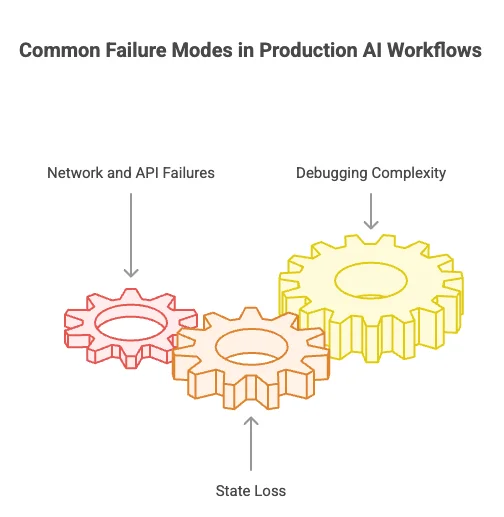
Common Failure Modes in Production AI Workflows
- Network and API Failures: A 30-minute research workflow might die at minute 29 due to a timeout or rate limit.
- State Loss: If a worker crashes mid-execution, the agent often loses all progress and must restart from scratch, wasting expensive compute resources.
- Debugging Complexity: Reconstructing what happened across dozens of parallel LLM calls is often described as “archaeology”.
When software moves from “generating answers” to executing work, the tolerance for failure becomes tiny—especially when workflows touch real systems (payments, payroll, ops, support tooling, supply chain).
How Temporal Enables AI Workflows
Temporal’s Series D announcement frames a shift in what customers are asking for: not just “make my workflow reliable,” but “build an AI system that doesn’t fall apart in production.” That shift is driven by agents that run for hours or days, branch based on model outputs, wait on external systems, and need to recover mid-execution rather than restarting from scratch.
In practice, production AI agents often need to:
- call tools and APIs under rate limits
- wait for external events or approvals
- handle retries and backoff
- maintain state (plans, tool results, partial progress)
- recover from crashes without redoing everything
If you’re already feeling the “prototype gravity” problem—where the agent works in a demo but gets brittle in staging—one way to unblock progress is to have a production engineer review and harden the workflow end-to-end. Xgrid supports this with forward-deployed engineers who embed with your team to design, ship, and validate durable workflows in your actual repos and delivery cadence.
Durable Agents and Tool Execution
Temporal has published AI patterns (e.g., cookbook-style guidance) where an agent’s tool calls map naturally to discrete execution units:
- tool calls can be logged, retried, and made recoverable
- workflow state persists through execution
- execution history becomes a first-class debugging asset
If you’re using an agent framework (or SDK-style integrations), the practical goal is the same: make model calls + tool interactions durable without turning the app into custom failure-handling glue.
Temporal $300M Series D Impact: Adoption Metrics, Scale, and Product Roadmap
For technical teams, funding matters less as hype and more as a proxy for procurement reality: survivability, roadmap velocity, operational maturity, and ecosystem depth—especially when orchestration becomes a dependency for mission-critical workflows.
Temporal’s announcement includes unusually specific adoption indicators:
- Revenue up >380% year over year
- Weekly active usage up 350%
- Installs up 500%, exceeding 20 million per month
- 9.1 trillion lifetime “action executions” on Temporal Cloud; 1.86 trillion for AI-native companies
It also emphasizes operational robustness, including handling spikes of 150,000+ actions per second and demonstrating disaster recovery behavior during major cloud outages.
Temporal states the funding will accelerate AI-native features, platform expansion, SDK developer experience, and partnerships (including OpenAI and Vercel), while hiring across the company. The press release also highlights platform initiatives such as Large Payload Storage, Task Queue Priority and Fairness, Execution History Branching, Temporal Nexus, and Serverless Execution—features that directly map to scaling, operability, and AI-like branching workflows.
Enterprise AI Workflow Orchestration at Scale: Who Uses Temporal and Why
Temporal’s momentum is reflected in the scale it cites and in the set of companies it highlights using the platform for long-running, fault-tolerant systems. In its announcement and press materials, Temporal points to organizations using the platform to power workflows that can’t afford downtime—examples include OpenAI, Replit, and Lovable for agentic systems at scale, and enterprises like ADP, Block, Yum! Brands, Nordstrom, and The Washington Post for mission-critical processes.
The common thread is that these systems aren’t “one call to a model.” They’re multi-step workflows that must remain correct over time, in the face of retries, partial failure, external dependencies, and changing inputs.
The AI Execution Layer for Agentic AI: Why Durable Execution Matters Next
The Series D funding will be used to expand Temporal Cloud and deepen AI workflow capabilities. As AI agents become more autonomous—moving money, managing payroll, orchestrating supply chains—Durable Execution is no longer an optimization; it becomes a gating factor for these systems to exist safely.
For developers, the promise is that the focus shifts away from stitching together “retries and state management” and back to innovating on the business logic of AI applications.
And if the gap you’re facing is less about whether Temporal can do this and more about how to implement it correctly inside your stack, Xgrid can help orchestrate Temporal in production workflows with a structure that consistently performs best: Problem → Outcome → Embedded Certified Engineer.
The idea is simple—identify where your workflows break in real-world execution, ship the durable patterns that prevent those failures, and do it with an engineer embedded in the same repos, PRs, and delivery cadence as your team—so what you end up with is production-grade workflows your team can extend safely.
FAQs
Why do AI agents fail in production?
Because production adds network failures, rate limits, state loss, concurrency, and debugging complexity across many tool calls and services.
How does Temporal help production AI workflows?
Temporal provides durable workflow execution—state persistence, retries, execution history, and recovery patterns—so multi-step agents can run reliably.
Do I need orchestration for every AI agent?
Not for simple, single-call tasks. But for agents that run long, call tools, wait on external events, or touch critical systems, orchestration becomes essential.
Related Articles
Related Articles

Established in 2012, Xgrid has a history of delivering a wide range of intelligent and secure cloud infrastructure, user interface and user experience solutions. Our strength lies in our team and its ability to deliver end-to-end solutions using cutting edge technologies.
NAVIGATE
Cloud & DevOps Web & Mobile Apps Temporal Digital Marketing GTM Engineering Marketo Consulting HubSpot Consulting Company Careers ResourcesOFFICE ADDRESS
US Address:
Plug and Play Tech Center, 440 N Wolfe Rd, Sunnyvale, CA 94085
Dubai Address:
Dubai Silicon Oasis, DDP, Building A1, Dubai, United Arab Emirates
Pakistan Address:
Xgrid Solutions (Private) Limited, Bldg 96, GCC-11, Civic Center, Gulberg Greens, Islamabad
Xgrid Solutions (Pvt) Ltd, Daftarkhwan (One), Building #254/1, Sector G, Phase 5, DHA, Lahore
Xgrid © 2026. All rights reserved.