
Construction Workforce Management Software: How to Fix Payroll, Safety, and Compliance Gaps


Construction projects are won or lost in the field. Schedules depend on crews arriving on time, completing tasks safely, using the right equipment, and accurately reporting progress. Yet many construction teams still manage critical workforce processes through unreliable mobile apps, paper logs, spreadsheets, GPS check-ins, and after-the-fact supervisor corrections.
That creates a painful gap between what happened on-site and what the business can prove.
A worker may have completed a full shift, but the timecard did not sync. A safety step may have been done, but the record is incomplete. A tool may have been checked out, moved between floors, and never returned. A manager may not know a crew is blocked until the end of the day. In high-pressure construction environments, these gaps turn into payroll disputes, compliance exposure, delays, and unnecessary cost.
The real purpose of construction workforce management software is not simply to digitize forms. It is to create a trustworthy operating record of the workday. For that to happen, the software must handle the realities of the field: poor connectivity, unreliable GPS, limited worker attention, safety gear, changing job-site conditions, and the need for low-friction adoption.
Key takeaways
- GPS-only check-ins can become unreliable indoors, underground, and around dense steel or concrete structures.
- In the field implementation documented by Xgrid, beacon-based check-ins and durable workflows increased payroll accuracy from approximately 80–85% to more than 99%.
- Automated tool custody tracking cut tool loss from $50,000+/site to near zero
- Compliance-as-code enforces safety rules in real time instead of after-the-fact paperwork
The Pain Point: Construction Teams Lose Control When Records Are Incomplete
Construction workforce management has several recurring problems.
- Payroll teams struggle with inaccurate or missing timecards. Supervisors spend hours reconciling who worked where and for how long. Workers become frustrated when they have to prove time that should have been captured automatically.
- Safety and compliance teams face a different challenge. They need records showing required steps were completed, but paper checklists and disconnected apps often produce fragmented evidence. If a safety briefing, inspection, or check-in is missing from the record, the organization may not be able to prove compliance later.
- Asset managers deal with tool and equipment loss. Expensive equipment moves across job sites, floors, storage areas, and crews. Without a reliable custody trail, losses are hard to prevent and harder to investigate.
- Executives and project leaders need visibility but often receive stale information. By the time a blocker appears in a report, the opportunity to fix it may have passed.
These problems are often treated separately. Payroll buys a timekeeping tool. Safety uses a checklist app. Operations uses spreadsheets. Asset teams use manual logs. But in the field, these workflows are connected. A worker’s shift, location, task, safety status, and tool usage are part of the same operational story.
Why GPS-Based Check-Ins Are Not Enough
Many construction workforce management platforms rely heavily on GPS. That may work for simple outdoor attendance, but it is not reliable enough for complex job sites.
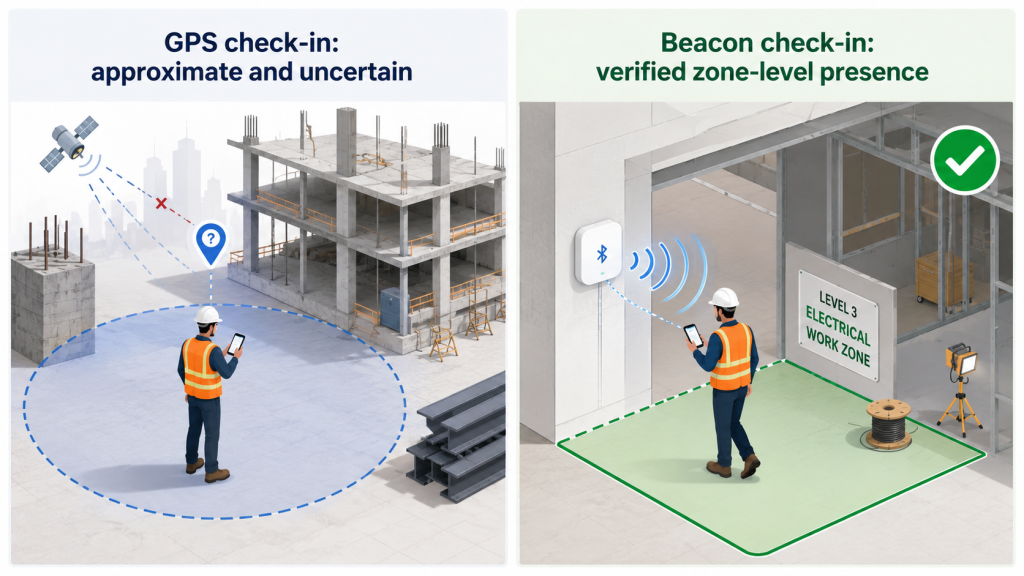
GPS can struggle indoors, underground, near tall buildings, around steel structures, or inside dense concrete environments. Even when it works, it may not provide the level of precision needed to confirm a worker is at the correct entrance, floor, zone, or room.
This creates a common problem: the system knows a worker is “near” a site, but not necessarily where they are supposed to be. For payroll, safety, and compliance, “near enough” is not always good enough.
Beacon-based check-ins offer a stronger approach. Bluetooth beacons can be placed at key site locations, entrances, floors, tool rooms, or work zones. When a worker’s mobile device detects a beacon, the system receives a stronger proof-of-presence signal than GPS alone can provide in difficult environments.
But beacon detection is only one part of the solution. The system also needs to process that event reliably, even if the network is unstable. That is where durable workflow orchestration becomes valuable.
The Solution: Connect Construction Workforce Management to Durable Workflows
A stronger software model treats each worker’s day as a workflow. Instead of storing disconnected updates across multiple systems, the platform records a timeline of field events: check-in, safety confirmation, task start, tool checkout, break, task completion, tool return, and checkout.
Temporal supports this model through durable execution, allowing long-running processes to preserve progress and recover when infrastructure, networks, or dependent services fail. The workflow does not disappear when a mobile device loses signal. It does not depend on a single app session. It can receive late events, preserve history, retry failed steps, and enforce business rules.
For construction workforce management software, this means the worker’s day becomes a reliable digital record. The system can answer practical questions:
Who was on-site?
When did they arrive?
Was the required safety step completed before work began?
Which task did they start?
Which tools were assigned to them?
Were those tools returned?
When did the worker check out?
What events affected payroll?
When these questions can be answered from one workflow history, payroll, safety, compliance, and operations all benefit.
Improving Payroll Accuracy with Workflow Histories
Payroll disputes often begin with missing or inconsistent records. A worker says they were on-site. The app says the check-in failed. The supervisor has a partial record. Payroll must decide what to trust.
A workflow-based system reduces this ambiguity. Every meaningful event is timestamped and added to the worker’s timeline. If the mobile device is offline, events can be stored locally and synced later. When the signal returns, the workflow updates the record.
This creates a more dependable payroll foundation because hours are based on validated field events rather than fragile app sessions or manual correction.
In the field implementation explored in Xgrid’s white paper, combining location-aware check-ins with durable workflow histories increased payroll accuracy from approximately 80–85% to more than 99%. The result demonstrates how reliable event capture can reduce the operational ambiguity created by failed check-ins, delayed synchronization, and manual timecard corrections.
When workers believe the system will accurately capture their time, they are less likely to work around it. When managers trust the record, they spend less time chasing corrections. When payroll has a durable event history, disputes become easier to resolve.
Making Compliance Part of the Workflow
Construction compliance cannot depend solely on people remembering to fill out forms after the fact. In the field, safety steps need to happen at the right moment, not merely be documented later.
A workflow-based platform can encode compliance rules directly into the process. For example, the system can require a safety briefing before a task can start. It can prevent checkout if tools are still assigned to a worker. It can flag missing inspections in real time instead of waiting for an audit.
This is often called compliance-as-code. The rules are not just written in a policy document. They are enforced by the software workflow.
That creates a major shift. Compliance stops being a paperwork burden and becomes part of how work naturally progresses. Supervisors no longer need to discover gaps days or weeks later. The workflow can surface problems immediately.
Reducing Tool Loss with Asset Custody Workflows
Tools and equipment loss can be expensive, especially across large job sites. The issue is not always theft. Sometimes tools are simply handed off, left behind, moved to another zone, or forgotten during checkout.
Construction workforce management software can help by tying tools to workflow events. A tool checkout becomes part of the worker’s shift history. A beacon zone can help confirm that a tool entered or exited a storage area. A checkout workflow can require tool return before the worker ends the shift.
The automated tool custody and location-aware logging reduced tool losses from more than $50,000 per site to near zero in the described case. That outcome is important because asset tracking creates direct cost savings and improves accountability without adding heavy administrative effort.
The goal is not to punish workers. It is to make custody visible, automatic, and fair.
Designing for Worker Adoption
Even the best construction workforce management software will fail if workers find it intrusive or difficult to use. Field teams are already dealing with physical work, safety requirements, schedules, and changing conditions. Software should reduce friction, not add another burden.
That is why beacon-triggered events, offline-first design, and workflow automation are so effective. Workers should not need to repeatedly prove where they are or manually reconstruct their day. The system should capture what it can automatically, prompt only when needed, and allow work to continue when offline.
Low-friction design also improves data quality. The fewer unnecessary taps required, the fewer chances for missed inputs, incomplete forms, or workarounds.
What Construction Leaders Should Look for in Workforce Management Software
When evaluating construction workforce management software, leaders should look beyond basic time tracking.
The platform should support offline-first field use. It should handle delayed event syncing without losing data. It should offer stronger location verification than GPS alone where needed. It should allow compliance rules to be embedded into workflows. It should provide an audit-ready history of field events. It should integrate with payroll, project management, and reporting systems. It should support real-time visibility for supervisors and executives.
Most importantly, it should treat field reality as the starting point. The system should not assume perfect networks, perfect GPS, or perfect user behavior.
Conclusion: Better Workforce Management Starts with a Better Record of the Workday
Construction workforce management is not just about tracking people. It is about protecting payroll accuracy, safety, compliance, asset custody, and operational visibility.
Traditional tools often fail because they capture fragments of the workday. A workflow-based approach captures the full sequence of events and connects them to business rules. With Temporal-powered durable workflows, construction teams can keep operating even when devices disconnect, signals drop, and field conditions become unpredictable.
The result is a more trustworthy record of work, fewer disputes, better compliance, lower tool loss, and stronger real-time control.
For construction leaders, that is more than software modernization. It is operational risk reduction.
Xgrid helps engineering and operations teams design and implement production-ready Temporal workflows for field environments where connectivity, location accuracy, and operational continuity cannot be taken for granted. From architecture and offline event synchronization to workflow reliability, observability, and safe modernization, Xgrid can help turn fragmented workforce processes into a dependable system of record.
Talk to Xgrid about your workforce workflow architecture.
FAQs: Construction Workforce Management Software
What is construction workforce management software?
Construction workforce management software helps manage field labor, time tracking, job-site attendance, safety steps, task progress, payroll records, and sometimes asset tracking across construction projects.
Why is GPS not always reliable for construction check-ins?
GPS can be inaccurate or unavailable inside buildings, underground areas, dense urban sites, or environments with steel and concrete interference. It may not verify the exact floor, zone, or work area.
How do beacon check-ins help construction teams?
Beacon check-ins use fixed Bluetooth beacons at known locations. When a worker’s device detects a beacon, the system can confirm proximity to a specific site area with less manual effort.
How can workforce software improve payroll accuracy?
By recording timestamped field events in a durable workflow history, the system gives payroll teams a more reliable source of truth for hours worked, breaks, task progress, and checkouts.
What is compliance-as-code in construction?
Compliance-as-code means safety and business rules are built directly into the workflow. For example, a task cannot start until a required safety step is completed.
Related Articles



Related Articles

Established in 2012, Xgrid has a history of delivering a wide range of intelligent and secure cloud infrastructure, user interface and user experience solutions. Our strength lies in our team and its ability to deliver end-to-end solutions using cutting edge technologies.
NAVIGATE
Cloud & DevOps Web & Mobile Apps Temporal Digital Marketing GTM Engineering Marketo Consulting HubSpot Consulting Company Careers ResourcesOFFICE ADDRESS
US Address:
Plug and Play Tech Center, 440 N Wolfe Rd, Sunnyvale, CA 94085
Dubai Address:
Dubai Silicon Oasis, DDP, Building A1, Dubai, United Arab Emirates
Pakistan Address:
Xgrid Solutions (Private) Limited, Bldg 96, GCC-11, Civic Center, Gulberg Greens, Islamabad
Xgrid Solutions (Pvt) Ltd, Daftarkhwan (One), Building #254/1, Sector G, Phase 5, DHA, Lahore
Xgrid © 2026. All rights reserved.