
Agentic AI with Temporal: From Prototypes to Production


TL;DR: How Temporal Makes Agentic AI Reliable
- Agentic AI fails in production without a reliable execution layer, not because of poor reasoning, but due to lost state, retries, crashes, and side effects.
- Temporal provides durable execution for AI agents, persisting state automatically and resuming workflows exactly where they left off after failures.
- Deterministic workflows + non-deterministic activities let AI agents make dynamic decisions while keeping execution reproducible and safe.
- Built-in retries, observability, and fault tolerance eliminate custom glue code for long-running, stateful AI automation.
Agentic AI – the paradigm of autonomous agents that can plan and execute tasks toward a goal – is rapidly moving from demos to real systems. Teams are increasingly building agentic AI systems by wiring LLMs to tools, giving them objectives like reducing incident MTTR, cleaning up cloud resources, or rolling out canaries—and letting them act.
But then, the reality hits.
- The agent runs for 45 minutes and your pod gets evicted.
- The model retries on its own and triggers a duplicate change request.
- Someone asks “what’s the current status?” and you have… logs.
- The agent “forgets” context because the process restarted.
This is where most agentic AI systems fail: not because the model can’t reason, but because the execution environment isn’t designed for long-running, stateful, side-effect-heavy automation. LLMs can decide what to do, but they don’t know how to persist state, recover from crashes, or safely retry failed actions.
To move from prototypes to production-grade autonomous systems, building agentic AI systems requires a reliable execution layer. That’s where an agentic AI solution through Temporal becomes essential.
Why Agentic AI Systems Break in Production Environments
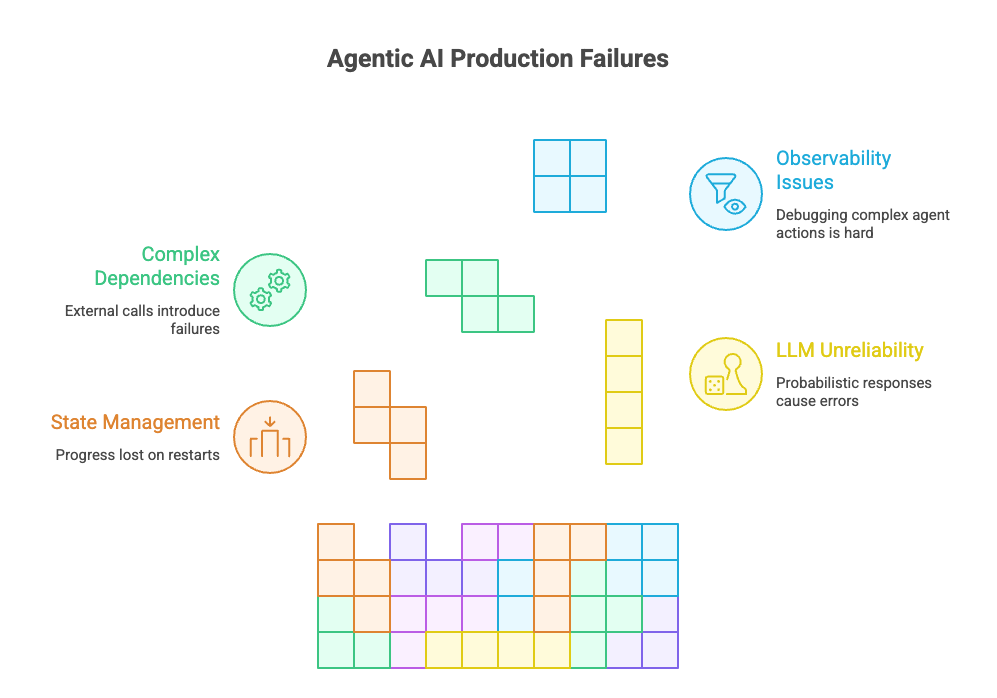
Unlike traditional chatbots that simply respond to prompts, agentic AI acts as a reasoning engine that can understand goals and adapt strategies in real time. However, this autonomy introduces significant operational hurdles:
- State Management: Agents often run for long durations—minutes, hours, or even days. This is the same class of problem seen in long-running workflows in domains like payments, onboarding, and financial reconciliation.
- Unreliability of LLMs: Large Language Models (LLMs) are probabilistic. They may return invalid data, time out, or hit rate limits.
- Complex Dependencies: Agentic AI systems rarely operate in isolation – they call external APIs, databases, and services. These calls introduce latency and failure modes (timeouts, rate limits, transient errors).
- Observability and Debugging: When an autonomous agent performs dozens of steps and API calls, figuring out what went wrong in the middle is challenging. Without proper instrumentation, you’re stuck with scattered logs.
How Temporal Enables Reliable Autonomous AI Workflows
Temporal is an open-source, stateful workflow orchestration engine. If the LLM is the brain—generating plans and making decisions—Temporal acts as the brainstem, ensuring those decisions are executed reliably, regardless of system failures.
Temporal introduces the concept of durable execution. It persists the state of a workflow automatically. If a process crashes, Temporal allows it to migrate to a new machine and resume exactly where it left off, with all local variables and history intact.
Here is how Temporal transforms the Agentic AI stack:
1. Stateful AI Agent Execution with Temporal Workflows
In traditional architectures, developers must manually save the agent’s state to a database at every step. With Temporal, state is stored in the workflow’s “virtual memory.” If an agent workflow halts unexpectedly, Temporal will transparently reschedule it and replay the events so the workflow can continue without losing progress.
Unlike in-memory frameworks where a crash drops all context, with Temporal the agent’s state (its goal, context, and history of actions) is never lost – the workflow simply resumes from the last known state. This enables long-running agentic AI solutions that can operate reliably for hours, days, or even months.
2. Fault Tolerance AI Agents with Built-In Retries
Agents interact with unreliable external tools (APIs, databases, search engines). Temporal handles this with fault-oblivious execution. You can attach a RetryPolicy to any action.
- Scenario: An agent tries to fetch market data, but the API is down.
- Without Temporal: The script crashes, or you write complex loop logic to retry.
- With Temporal: The engine automatically retries based on your policy (e.g., exponential backoff) without you writing a single line of exception handling code inside the business logic.
This dramatically simplifies AI agent development solutions and reduces operational risk.
3. Deterministic Workflows, Dynamic Decisions
Temporal keeps workflow code deterministic while allowing AI agents to make dynamic decisions. The workflow defines structured control flow—“ask the LLM, execute the action, repeat”—while unpredictable work happens in activities. Temporal records each decision and result, replaying them on restart instead of re-running the LLM. The agent’s behavior stays flexible, but execution remains reproducible, letting it resume exactly where it left off without duplication or divergence.
4. Scaling AI Agents with Temporal Workflow Orchestration
Temporal is built to scale horizontally and can run thousands or millions of workflows concurrently. This makes it suitable for scaling individual agents, multi agent AI systems, or entire fleets of Temporal AI agents without custom schedulers or coordination logic.
Agents can run independently or spawn child workflows, while Temporal handles load balancing and fault isolation automatically.
5. Observability and Debugging for Long-Running AI Agent Workflows
Temporal provides deep visibility into agent execution. Every decision and action is recorded in an event history that can be inspected via UI or CLI. Developers can query live workflow state, send signals for human input, and replay executions to debug failures.
This level of observability is critical for building agentic AI systems that must be auditable, debuggable, and safe in production.
MOVING AGENTIC AI FROM PROTOTYPE TO PRODUCTION?Agentic AI prototypes often break under real-world failures like crashes, rate limits, tool errors, duplicate side effects, long-running state, and unclear debugging paths. Xgrid’s Temporal practice helps teams design durable agent loops, isolate LLM and tool calls into Activities, configure retries, add human-in-the-loop controls, and make execution observable through Event History and Search Attributes. |
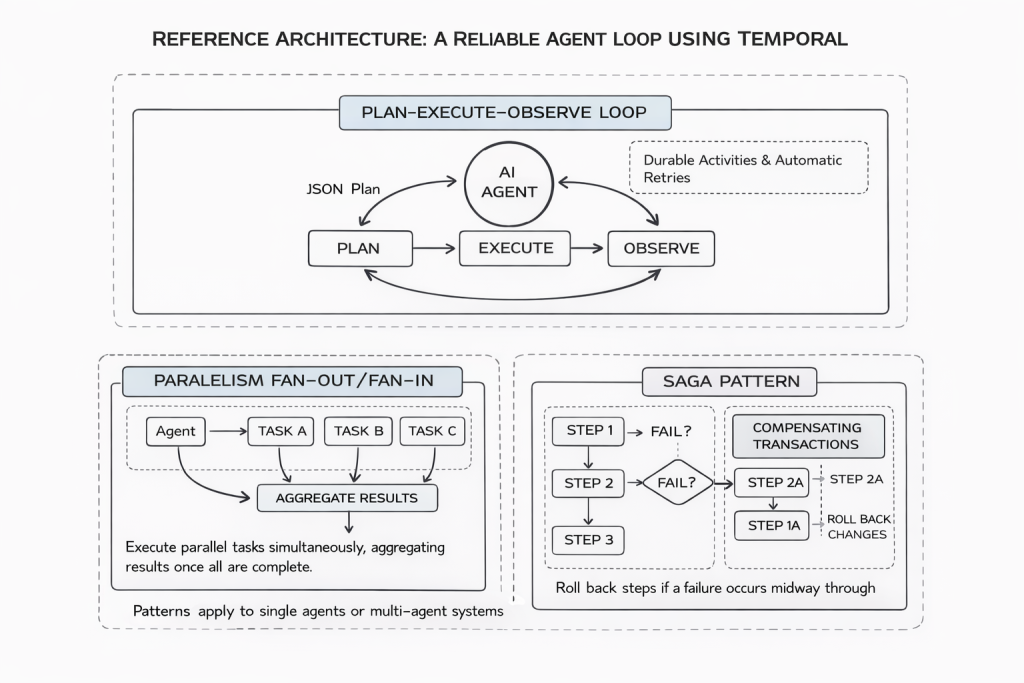
Reference Architecture: A Reliable Agent Loop Using Temporal
By leveraging Temporal, developers can implement sophisticated design patterns that are otherwise difficult to manage:
- The Plan-Execute-Observe Loop: The AI generates a plan (JSON steps), and Temporal executes them as durable activities. If a step fails, Temporal catches it, allowing the AI to adjust the plan dynamically.
- Parallelism (Fan-Out/Fan-In): An agent needs to research five different topics simultaneously. Temporal can spawn parallel activities to fetch this data and aggregate the results (Fan-In) once all are complete, optimizing speed without sacrificing reliability.
- Saga Pattern: If a multi-step transaction fails halfway through (e.g., money is deducted but the order fails), Temporal can execute “compensating transactions” to roll back the changes, ensuring data consistency.
These patterns apply equally to single agents and multi agent AI systems coordinating complex workflows.
Production readiness checklist for agentic AI with Temporal
Before shipping agentic AI workflows with Temporal, confirm:
- Agent goals, context, and action history persist in Workflow state
- LLM calls, tool calls, API requests, and database writes run as Activities
- Retry policies are tuned for rate limits, timeouts, and transient tool failures
- Human input, approvals, and async events use Signals, Updates, or Queries intentionally
- Event History, Search Attributes, and activity logs make failed agent runs easy to inspect
Example: Building an AI Agent Workflow with Temporal
An agentic AI workflow with Temporal follows a simple pattern: start with a goal, ask LLM what to do next, execute the chosen action, and repeat until the goal is met. Temporal provides the durable structure needed to run this loop reliably over long periods.
Workflow and LLM Decisions
The Temporal workflow defines the agent’s control logic and maintains state. It runs a deterministic loop that invokes an LLM through an activity to decide the next action. While the model’s output is non-deterministic, Temporal records each decision so it can be replayed without re-running the model.
Python
@workflow.defn
class AIAgentWorkflow:
@workflow.run
async def run(self, user_goal: str) -> str:
conversation_history = []
while not self.is_goal_achieved(conversation_history):
next_action = await workflow.execute_activity(
llm_decide_next_action,
{“goal”: user_goal, “history”: conversation_history},
start_to_close_timeout=timedelta(seconds=30),
)
result = await workflow.execute_activity(
next_action.tool_name,
next_action.tool_params,
start_to_close_timeout=timedelta(seconds=30),
)
conversation_history.append(
{“action”: next_action, “result”: result}
)
return self.format_final_result(conversation_history)
Tool Execution, Signals, and Scaling
Each action is implemented as an activity that performs real side effects, such as calling external APIs. Temporal guarantees these actions execute at least once and replays their results after failures, keeping execution consistent. Workflows can also pause and wait for
signals to handle human input or asynchronous events. Once deployed, agent workflows scale by adding workers, while Temporal manages retries, backpressure, and observability—turning agentic AI into a production-ready system.
Frequently Asked Questions (FAQs)
What Is Agentic AI?
Agentic AI refers to autonomous systems that can reason about goals, plan multi-step actions, use tools, and adapt their behavior based on outcomes—without constant human intervention.
Why Do Agentic AI Systems Fail in Production?
Agentic AI Systems fail in production because most execution environments are not designed for durable, stateful automation with retries, observability, and failure recovery.
How Does Temporal Enable Reliable Agentic AI?
Temporal provides a durable execution layer for Temporal AI agents, ensuring safe retries, deterministic recovery, and full execution visibility.
Can Temporal Scale to Large Numbers of AI Agents?
Yes. Temporal is well-suited for scaling fleets of agents and multi agent AI systems running concurrently.
From AI Prototypes to Production-Grade Agentic Systems
As we enter the era of autonomous systems, the gap between an AI prototype and a production-ready solution is the infrastructure of reliability. By combining the cognitive power of AI with the durable execution of Temporal, organizations can build agentic workflows that are not only “smart” but also scalable, debuggable, and trustworthy.
You’ve seen why durable execution is essential for agentic AI in production. The remaining challenge is getting from architecture diagrams to a real, running workflow your team can build on. Xgrid works with teams to forward-deploy Temporal engineers alongside your developers, shipping an initial production workflow quickly so adoption becomes real.
Ready to eliminate infrastructure overhead? Work with Xgrid’s Temporal experts.
Related Temporal and agentic AI guides
- For the broader multi-agent coordination problem, read: Agentic AI Orchestration with Temporal: Solving Multi-Agent System Challenges
- For sandboxed agents, durable sessions, and OpenAI Agents SDK architecture, read: Temporal + OpenAI Agents SDK Sandbox: What It Means for Production AI Workflows
- For common production failure patterns in Temporal-based AI agents, read: Temporal AI Agent Orchestration: 11 Production Failure Patterns
- For long-running agent memory, state loss, crash recovery, and durable execution, read: Why Long-Running AI Agents Crash — Fix with Temporal
Related Articles
Related Articles

Established in 2012, Xgrid has a history of delivering a wide range of intelligent and secure cloud infrastructure, user interface and user experience solutions. Our strength lies in our team and its ability to deliver end-to-end solutions using cutting edge technologies.
NAVIGATE
Cloud & DevOps Web & Mobile Apps Temporal Digital Marketing GTM Engineering Marketo Consulting HubSpot Consulting Company Careers ResourcesOFFICE ADDRESS
US Address:
Plug and Play Tech Center, 440 N Wolfe Rd, Sunnyvale, CA 94085
Dubai Address:
Dubai Silicon Oasis, DDP, Building A1, Dubai, United Arab Emirates
Pakistan Address:
Xgrid Solutions (Private) Limited, Bldg 96, GCC-11, Civic Center, Gulberg Greens, Islamabad
Xgrid Solutions (Pvt) Ltd, Daftarkhwan (One), Building #254/1, Sector G, Phase 5, DHA, Lahore
Xgrid © 2026. All rights reserved.