
How Xgrid Turned a Crowded HubSpot Portal Into a Qualification-First Sales Engine
From years of CRM buildup to cleaner reporting, faster follow-up, clearer ownership, and a pipeline that reflects real sales opportunities.
Executive Summary
The CRM Was Not Short on Data. It Was Short on Clarity.
For a bus sales and marketplace company, a serious buyer rarely arrives through one neat channel.
They may submit a web form, call, leave a voicemail, send a text, or book a meeting. HubSpot therefore had to do more than store contacts — it had to keep every interaction connected, owned, and ready for follow-up.
Over time, the company's HubSpot portal had accumulated more than 500 reports, overlapping workflows, legacy fields, multiple call and messaging integrations, and a deal pipeline that treated many raw inquiries like qualified opportunities.
The system still held valuable data, but finding the right signal — and acting on it consistently — was getting harder.
Operational Audit Across 8 Core Surfaces:
The Outcome
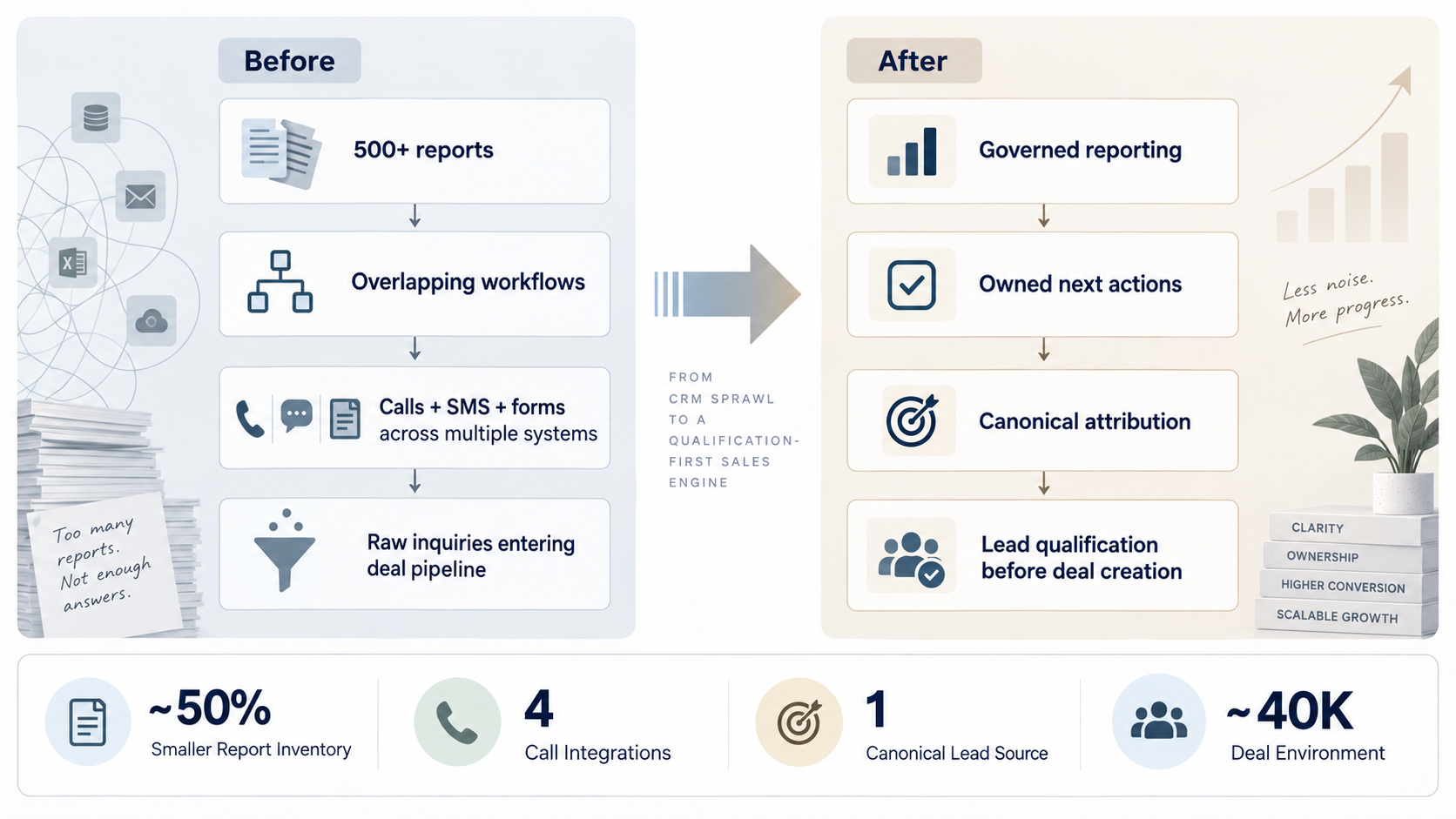
- Roughly half the report inventory
- More reliable follow-up across four call integrations
- One source-of-truth field for attribution
- A deal pipeline that no longer needs to absorb every unqualified inquiry
The team rebuilt the most important paths from first inquiry to qualified opportunity: removing more than 250 outdated reports, introducing a pre-deal Leads object, repairing ownership across call and message activity, adding follow-up automation, creating one canonical lead source, and testing major pipeline changes in a sandbox before production release.
Engagement at a Glance
| Dimension | Engagement Details |
|---|---|
| Industry | Bus sales and marketplace operations |
| HubSpot stack | Marketing Hub Enterprise, Sales Hub Enterprise, and Data Hub Professional |
| Scope | CRM audit, remediation, automation, integrations, reporting, attribution, pipeline redesign, and sales enablement |
| Connected ecosystem | HubSpot with RingCentral, CallRail, RingCentral AI Receptionist, RingSense, Salesmsg, and supporting tools |
| Delivery model | Direct collaboration between business stakeholders and Xgrid HubSpot specialists |
Sales Dynamics
Why This Sales Process Put Extra Pressure on HubSpot
Selling buses is a high-consideration, consultative process.
A buyer may need direct guidance before committing to a vehicle, and the first meaningful interaction can come from almost anywhere:
That makes CRM coordination especially important. The right representative needs the right context quickly, while management needs reporting that reflects actual qualification — not simply raw activity.
As the portal grew, the challenge became less about adding tools and more about getting the existing system to behave like one connected revenue operation.
Consultative Revenue Requirements
High-ticket inventory transactions require flawless CRM execution:
- Every inquiry must reach an assigned owner immediately.
- In-flight voice, SMS, and AI logs must attach to the same buyer profile.
- Pipeline metrics must differentiate raw interest from qualified buyers.
- Attribution must pinpoint which multi-touch campaigns drove the deal.
The Challenge
HubSpot Had Grown Faster Than the Operating Model
The company already had an enterprise-grade HubSpot stack and a growing set of sales integrations.
But years of configuration changes and multiple vendor touchpoints had created CRM sprawl: duplicate reports, inconsistent naming, overlapping automations, routing gaps, legacy properties, and a pipeline carrying far more records than the sales team considered true opportunities.
Reporting Sprawl
More than 500 reports existed, including duplicates, unused assets, and reports based on deprecated properties.
Automation Drift
Some workflows overlapped, referenced legacy fields, or contained record-management logic that needed review.
Follow-up Gaps
Certain forms, voicemails, and after-hours AI Receptionist conversations did not always create a clear next action.
Ownership Inconsistency
Outbound calls and SMS activity could be assigned incorrectly or remain unowned. Duplicate contacts also split activity between representatives.
Attribution Friction
Users often had to inspect three to four HubSpot properties simply to understand where a contact originated.
Pipeline Distortion
Roughly 40,000 deals had accumulated because inquiries could become deals before qualification. About 33,000 were marked lost.
The Priority Order Mattered
Xgrid did not treat every asset as equally urgent. Anything that could lose buyer context, delay follow-up, misassign ownership, or distort reporting moved ahead of cosmetic cleanup.
What Xgrid Found in the First Pass
| Area | What was happening | Priority |
|---|---|---|
| Reporting | 500+ reports; 250+ were duplicate, outdated, low-use, or deprecated | HIGH |
| Automation | Overlapping workflows, legacy-property updates, missing actions, and risky deletion logic | CRITICAL |
| Follow-up | Some forms, voicemails, AI conversations, and other inquiry paths lacked a clear next action | CRITICAL |
| Attribution | Source data was spread across 3–4 properties and multiple integration signals | HIGH |
| Integrations | Four call sources plus SMS used different ownership and activity-handling rules | HIGH |
| Lifecycle | Inquiries could enter the deal pipeline before qualification | CRITICAL |
The Rebuild
The Goal: Make Every Important Interaction Easier to Act On
Xgrid used a phased approach so the live CRM could improve without creating a second wave of disruption.
Each phase tied a technical change to a concrete sales or management outcome.
1. Cut Report Sprawl in Half
The reporting audit covered more than 500 HubSpot reports. Xgrid removed more than 250 duplicate, irrelevant, empty, or deprecated reports and retained roughly 250 that still served a valid business purpose.
The surviving reports were renamed as plain-English business questions so users could search by what they wanted to know rather than by an internal naming convention.
- Roughly 50% smaller report inventory;
- Question-based report names that were easier to discover and understand;
- Cleanup of empty dashboards and layouts broken by removed panels; and
- A contact-and-deal conversion report combining calls, form fills, and associations to improve funnel analysis.
2. Make Every Inquiry Trigger the Next Action
A form is not operationally healthy simply because it accepts a submission. Xgrid checked whether each active form actually triggered the expected path:
Tasks → Notifications → Ownership changes → Follow-up steps
Two to three forms needed downstream follow-up that was not yet automated, so those actions were added after validation with stakeholders.
The workflow audit also surfaced duplicated automation, references to deprecated fields, and a high-risk rule that could delete a bounced contact even when that contact had an associated deal. Logic was revised to preserve valuable sales history.
3. Fix Ownership Across Calls, Voicemail, and SMS
Calls were syncing from four independent sources: RingCentral, CallRail, RingCentral AI Receptionist, and RingSense.
The audit found that ownership and follow-up behavior varied by source. Outbound calls could land under the wrong representative, while voicemails and after-hours AI conversations could appear in HubSpot without becoming actionable work.
Xgrid added routing, notifications, and task creation so synced events reached the correct person with an explicit next step. For RingCentral SMS activity, the team built a custom-coded number-to-representative mapping because the native sync did not reliably identify the sender or recipient owner.
4. Catch Duplicate Contacts Without Risky Auto-Merges
One buyer could enter through a phone call and later submit a form with an email address. HubSpot could treat those interactions as separate contacts, assign them to different representatives, and split the buyer's history.
Xgrid designed duplicate-detection logic using:
Name + Email + Phone
The logic was rolled out in staged progression: Flag likely duplicates → Validate match logic → Move toward automated merging, rather than starting with risky automatic merges that could irreversibly destroy sales context.
5. Stop Treating Every Inquiry Like a Deal
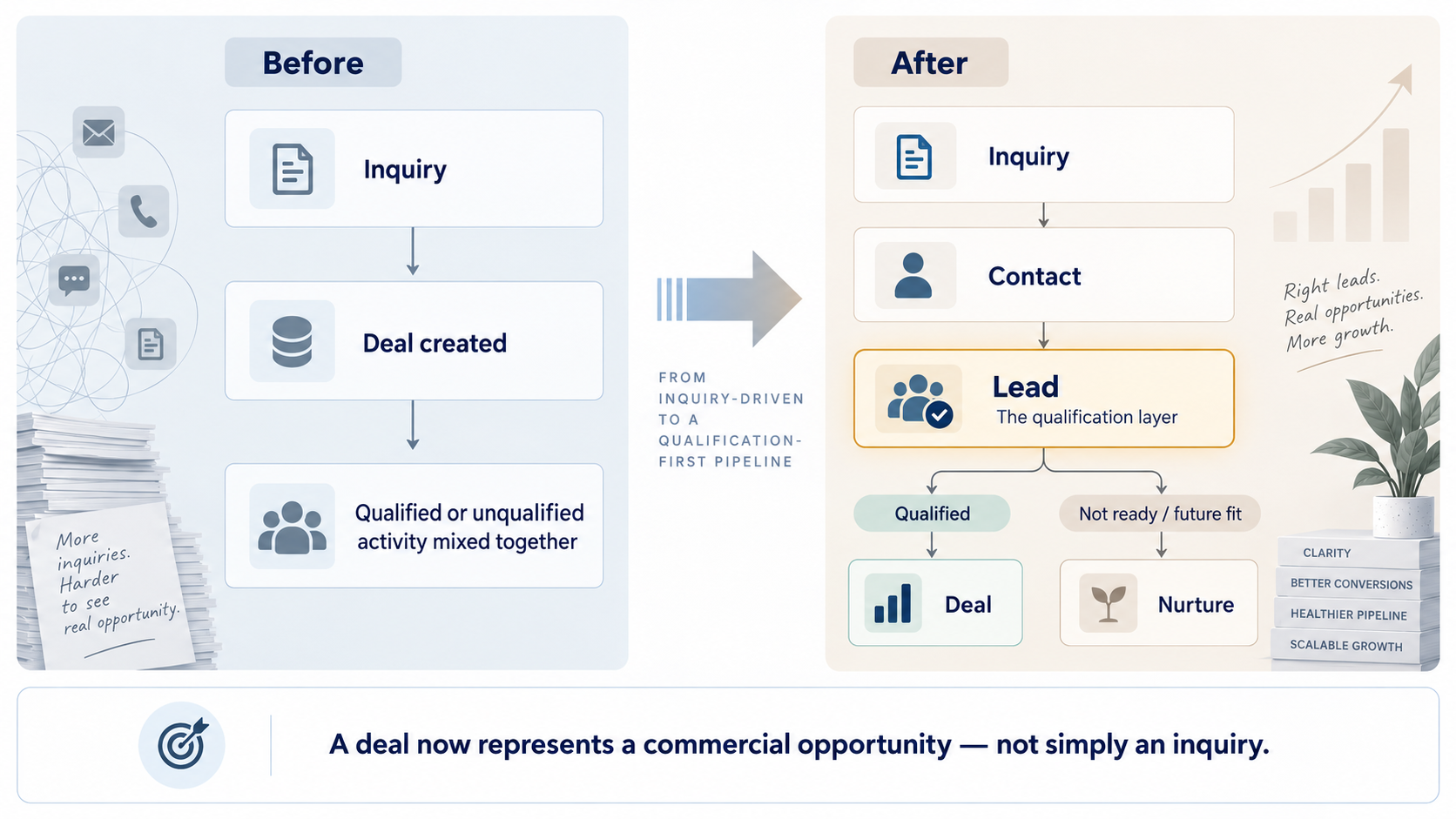
The biggest structural change was the introduction of HubSpot's Leads object as a pre-deal qualification layer.
Instead of creating a deal as soon as a contact entered the CRM, automation now creates a lead for a representative to work. A deal is created only when the prospect is actually qualified to do business.
The New Lifecycle Model
| Object | Role |
|---|---|
| Contact | The person and the complete engagement history |
| Lead | The sales team's pre-deal qualification work |
| Deal | A qualified commercial opportunity with meaningful pipeline value |
| Nurture | A future-fit or not-yet-ready relationship that should remain available without distorting active pipeline |
The pipeline itself was simplified too. “New Inquiry” and “Qualify” were consolidated, the “Stagnant” stage was removed, and a clearer path was established for non-fit or future-business records. Approximately 31,000 stale or non-fit records illustrated the scale of the transition planning, so the change was staged with strict governance.
6. Test the Risky Changes Somewhere Safe
Sales representatives were understandably cautious about changing a live deal process they used every day.
Xgrid created a production-mirrored HubSpot sandbox to demonstrate the future-state pipeline, test automations, identify downstream effects, and validate changes before touching active records. After rigorous stakeholder validation, the updated pipeline assets were rolled into production with zero reported breakages from the release.
Sales Enablement & Operations
Making the System Easier to Run
The Rebuild Was Not Only About Cleanup — It Changed How the Team Worked
7. Give Representatives One Place to Work
Xgrid configured HubSpot Sales Workspace so representatives could see assigned leads, tasks, upcoming meetings, contacts needing follow-up, and active deals in one place.
High- and low-priority tasks were separated, while pipeline metrics and filters made overdue tasks and stagnant follow-up easier to identify. Routing was also simplified toward one master workflow with branches for different representatives, reducing the maintenance burden created by isolated routing files.
8. Make Booked Meetings Follow the Right Owner
The website did not previously offer an immediate meeting option for prospects with urgent or priority needs. Xgrid added a round-robin HubSpot meeting scheduler to the form thank-you page with a one-hour minimum notice buffer.
To eliminate the edge case where a contact was owned by one representative while the scheduler assigned the meeting to another, a dedicated workflow aligned contact ownership with meeting ownership, giving the buyer one accountable point of contact.
9. Collapse Attribution Into One Source of Truth
Answering “Where did this lead come from?” previously required checking three or four disparate HubSpot properties.
Xgrid created custom logic that evaluated roughly 7–8 relevant signals and wrote the final result into standardized Lead Source and Lead Medium fields. Inputs from Google Ads, Facebook Ads, CallRail, RingCentral, and direct Website visits were translated into one consistent reporting model, complemented by a CallRail attribution report connecting tracked numbers back to campaigns.
10. Turn Call Data Into Sales Enablement
Call recordings and transcripts were already being generated across the telephony stack.
Xgrid converted that archive into an actionable insights repository containing recurring buyer questions, effective representative responses, and an ideal AI response for each question. The same knowledge base supported both rapid onboarding for new sales representatives and prompt training for the RingCentral AI Receptionist.
11. Protect Outbound Caller Reputation
Several outbound numbers were being flagged as “Spam Risk,” creating a severe conversion barrier outside the CRM itself.
Xgrid coordinated registration through the Free Caller Registry and the major carrier-analytics ecosystems (Hiya, First Orion, TNS). High-risk legacy numbers were retired rather than recycled, and representatives were trained to use their designated direct lines in HubSpot instead of accidentally calling from generic toll-free numbers.
Results & Impact
A Cleaner CRM, a More Honest Pipeline, and Fewer Places for Leads to Disappear
The strongest results are improvements in system health, operational control, and measurement readiness.
Those gains create the foundation for conversion and revenue analysis without overstating sales outcomes that have not yet been validated over a fixed post-launch period.
Operational Transformation: Before vs. After
| Area | Before | After / Improvement |
|---|---|---|
| Reporting | 500+ reports with duplicates and deprecated logic | ~250 retained; 250+ removed; roughly 50% smaller inventory |
| Report discovery | Inconsistent names and unclear purpose | Question-based naming aligned to business decisions |
| Attribution | Manual review across 3–4 properties | 1 canonical source populated from ~7–8 signals |
| Lead qualification | Every inquiry could become a deal | Leads object qualifies prospects before deal creation |
| Historical pipeline | ~40,000 deals; ~33,000 marked lost | Root cause addressed so new non-fit inquiries do not recreate the distortion |
| Forms | 2–3 desired follow-up paths missing | Validated follow-up tasks and notifications configured |
| Call operations | 4 integrations with routing and follow-up gaps | Ownership, task creation, and event visibility improved |
| Voicemails / AI | Hundreds could surface only after 5–6 days | Automated notifications and follow-up tasks on synced events |
| SMS ownership | Activities unassigned to representatives | Custom number-to-representative mapping in HubSpot |
| Pipeline release | High-risk live change | Sandbox-tested rollout with no reported breakage |
Results
Operating Principles
What Made the Approach Work
The Technical Work Followed a Few Simple Operating Principles
Direct Specialist Access
Business stakeholders worked directly with the Xgrid administrators doing the work, shortening the distance between a question and a technical answer.
Evidence Before Automation
Duplicate rules were tested before automated merging, and major pipeline changes were proven in a sandbox before release.
Business Outcomes Over Asset Counts
Reports, forms, workflows, and integrations were judged by the questions they answered and the actions they triggered — not simply by whether they existed.
Edge Cases Handled Early
Ownership conflicts between contacts and meetings were solved before they became recurring sales friction.
One Foundation for Scale
Data hygiene, lifecycle design, routing, attribution, reporting, and enablement were brought under consistent rules so future improvements had something stable to build on.
Playbook
What Other HubSpot Teams Can Learn From This
Protect Data Integrity First
Disable or redesign automation that can delete records, sever associations, or overwrite trusted fields.
Standardize Revenue-Critical Follow-Up
Every active form, voicemail, AI handoff, call, and message should create an owned next action when follow-up is expected.
Establish Ownership and Identity
Resolve duplicates and make sure activities belong to the representative who actually performed or received them.
Separate Qualification From Opportunity
Do not let raw inquiries enter the deal pipeline before they meet the business definition of a qualified opportunity.
Standardize Attribution and Lifecycle Rules
Canonical fields make reporting repeatable and reduce manual interpretation across conflicting properties.
Clean Reporting After the Process Is Stable
Removing reports is useful, but only after the underlying data and lifecycle definitions are trustworthy.
Continuous Evolution
What Comes Next
With the core CRM foundation in place, the company can shift from remediation to continuous optimization.
Current and Proposed Optimization Work
- Improving outbound email deliverability through Apollo;
- Refining RingSense and AI Receptionist event summaries;
- Maintaining dashboards organized strictly around real business questions; and
- Measuring the impact of the new operating model over defined time windows.
A Useful 30-, 60-, and 90-Day Scorecard
- Median time from inquiry to first owned sales action
- Percentage of form fills, voicemails, and AI conversations with a follow-up task
- Owner-assignment accuracy across calls, SMS, forms, and meetings
- Duplicate-record rate and false-positive merge rate
- Canonical lead-source completeness and attribution accuracy
- Lead-to-qualified-deal conversion rate
- Closed-lost reason quality and pipeline-stage aging
- Report usage, duplicate-report creation, and dashboard health
Strategic Outcome
A HubSpot Foundation Designed to Scale Without Recreating the Same Problems
The company now has a cleaner HubSpot foundation that can support growth without recreating the same reporting, routing, attribution, and lifecycle problems at a larger scale.
Frequently Asked Questions
Frequently Asked Questions About HubSpot CRM Optimization
How did Xgrid improve HubSpot reporting?
How did Xgrid improve lead follow-up?
How was HubSpot lead-source attribution improved?
Why use a HubSpot sandbox for CRM optimization?
What changed as a result of the HubSpot CRM optimization?
Talk to a HubSpot Specialist
Is Your HubSpot Portal Growing Faster Than Your Sales Process?
Xgrid helps teams improve CRM structure, lifecycle design, attribution, reporting, automation, integrations, and sales follow-up so HubSpot reflects how the business actually operates.
Share Your Details

Established in 2012, Xgrid has a history of delivering a wide range of intelligent and secure cloud infrastructure, user interface and user experience solutions. Our strength lies in our team and its ability to deliver end-to-end solutions using cutting edge technologies.
NAVIGATE
Cloud & DevOps Web & Mobile Apps Temporal Digital Marketing GTM Engineering Marketo Consulting HubSpot Consulting Company Careers ResourcesOFFICE ADDRESS
US Address:
Plug and Play Tech Center, 440 N Wolfe Rd, Sunnyvale, CA 94085
Dubai Address:
Dubai Silicon Oasis, DDP, Building A1, Dubai, United Arab Emirates
Pakistan Address:
Xgrid Solutions (Private) Limited, Bldg 96, GCC-11, Civic Center, Gulberg Greens, Islamabad
Xgrid Solutions (Pvt) Ltd, Daftarkhwan (One), Building #254/1, Sector G, Phase 5, DHA, Lahore
Xgrid © 2026. All rights reserved.