
How Xgrid Rebuilt a Local Acquisition Engine to Lift Search Clicks by 55%
A faster website, geo-specific landing pages, and clearer intent matching helped a US service business move from page-four visibility to page one — while protecting the paid traffic and conversion paths already in market.
Strategic Overview
Why This Matters for Campaign Teams
Paid media can create demand, but conversion still depends on where the click lands.
This engagement rebuilt the underlying acquisition experience so local and regional traffic could reach faster, more relevant pages without disrupting ongoing marketing.
Measurement Note
The quantified uplift in this case study comes from organic search performance.
Paid traffic was already active, and the website changes were implemented without disrupting those paid acquisition and conversion paths.
The Challenge
The Acquisition Problem Wasn’t Demand. It Was the Destination.
The client is a US-based professional knife-sharpening business built around convenience and local accessibility, with both door-to-door pickup and drop-off and mail-in service.
The business already had real customer demand, but its digital presence was not capturing that intent effectively.
For both organic and paid acquisition, that creates the same problem: even when a potential customer is searching, clicking, or arriving from a campaign, the website has to make the service, location, and next action immediately clear.
Visibility Existed. Conversion Opportunity Was Leaking.
The site appeared in search, but:
- rankings were low;
- click-through was weak; and
- local intent was not mapped cleanly to the pages users reached.
Baseline Metrics
Baseline: The Previous Three Months
| Metric | Baseline | What it signaled |
|---|---|---|
| Clicks | 385 | Low capture of existing search demand |
| Impressions | 25,000 | Search visibility existed, but not strongly enough |
| CTR | 1.5% | Search listings and page relevance were underperforming |
| Average position | 31.8 | Most visibility sat around page four, away from high-intent clicks |
Improve the website aggressively enough to unlock growth, but carefully enough that active acquisition channels did not lose their landing pages, conversion paths, or momentum.
Website Constraints
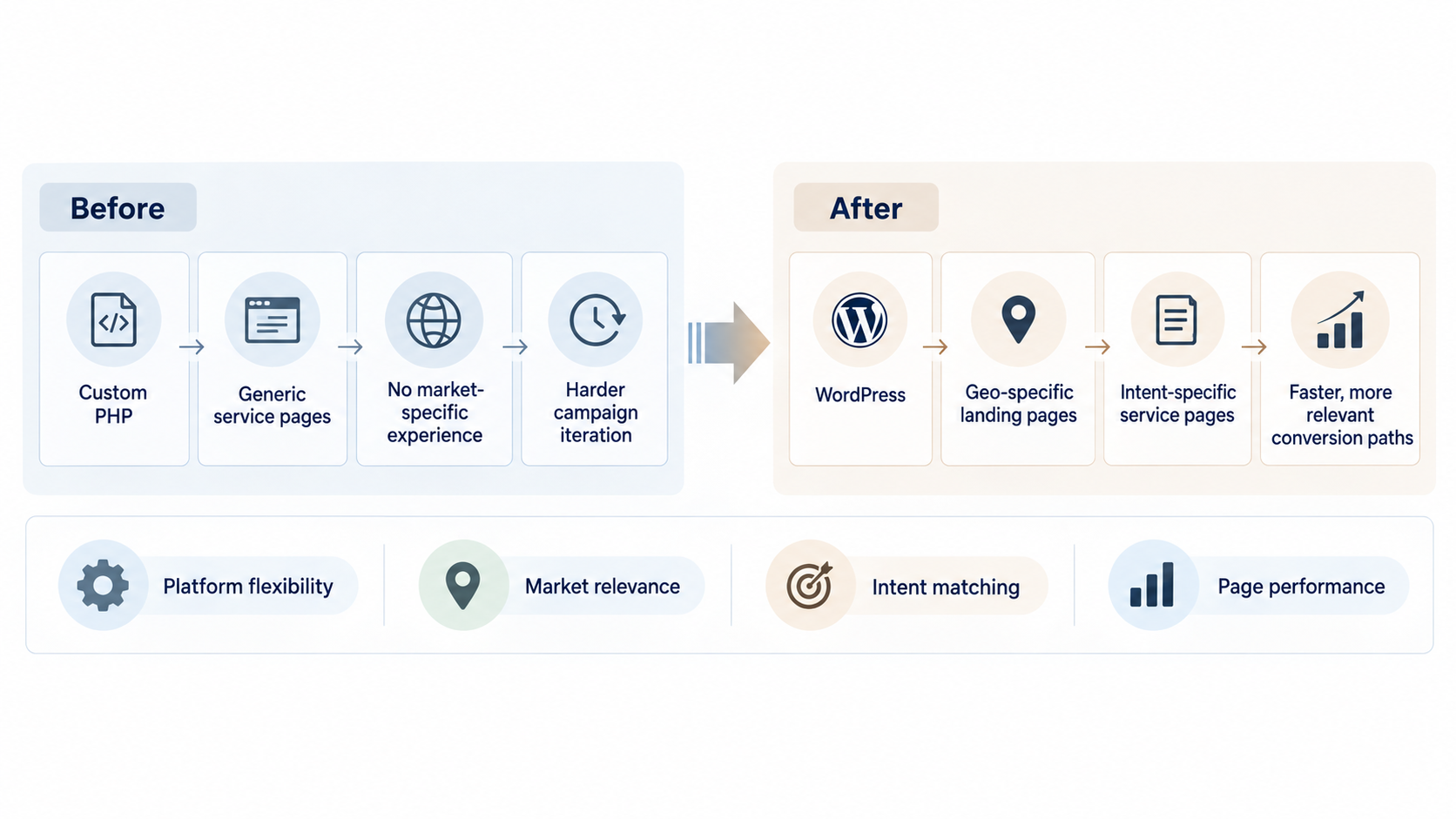
Custom PHP
The existing custom PHP setup made fast landing-page iteration difficult.
Performance
Core Web Vitals and page performance needed improvement.
Broad Service Categories
Service categories were too broad to capture specific intent effectively.
Campaign Constraints
No dedicated location pages
Geo-specific demand did not have a destination tailored to the market.
Generic messaging
Broad messaging weakened query-to-page alignment.
Active acquisition had to remain protected
Any major website changes had to preserve the paid traffic and conversions already running.
The Rebuild
Structure the Site Like a Campaign System
Xgrid treated the website as acquisition infrastructure.
Every technical change had to make it easier to launch, target, and convert high-intent traffic across locations and service needs.
1. Move From Custom PHP to WordPress
The migration created a more flexible operating layer for:
- faster updates;
- repeatable page templates;
- better performance optimization; and
- scalable SEO practices.
2. Build Geo-Specific Landing Pages
Dedicated location pages made service availability explicit by region.
Instead of directing every visitor to one generic destination, local-intent traffic could now land on a page that was more relevant to the market being searched.
3. Segment Services Around Intent
Sharpening services were expanded into clearer categories so different search needs could resolve to pages that matched the user’s specific problem.
4. Improve Relevance and Page Performance
Metadata was rewritten around real service queries.
At the same time, Core Web Vitals and page speed were improved to strengthen the experience after the click.
Paid Acquisition Relevance
Better Campaigns Need Better Destinations
The same architecture that improved organic visibility also created a cleaner foundation for geo-targeted paid acquisition:
- Market-specific pages
- Tighter intent matching
- Faster iteration
- A more consistent landing experience
What Xgrid Did Not Do
Xgrid did not treat SEO, paid media, and the website as isolated workstreams.
The rebuild focused on the shared layer underneath them — the pages, structure, and performance that determine whether high-intent traffic can actually convert.
Results
More of the Existing Demand Started Turning Into Visits
Over the following three months, performance improved across every measured search metric.
The largest change was not impressions — it was the site’s ability to earn more clicks from the demand already available.
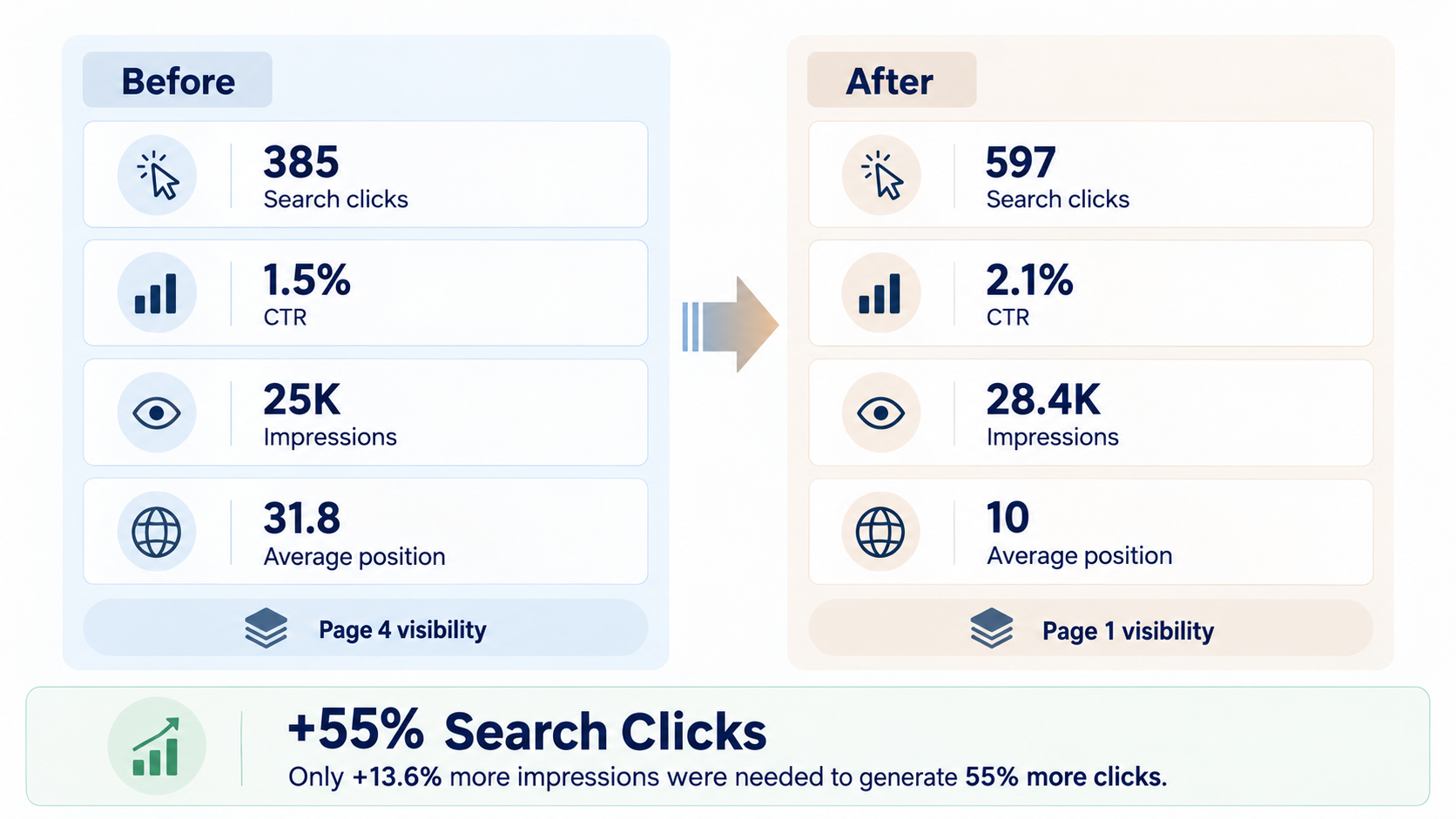
Search Performance: Before vs. After
| Metric | Before | After | Change |
|---|---|---|---|
| Search clicks | 385 | 597 | +55% |
| Impressions | 25.0K | 28.4K | +13.6% |
| CTR | 1.5% | 2.1% | +40% |
| Average position | 31.8 | 10 | +21.8 positions |
What Changed for Acquisition
Analysis
WHAT THE NUMBERS DO — AND DO NOT — SHOW
These results are measured from organic search, not paid-ad dashboards.
The paid-media value is the infrastructure created around those results:
- faster pages;
- regional landing experiences;
- stronger message-to-page alignment; and
- continuity for traffic already being purchased.
The Takeaway
A 13.6% increase in impressions produced a 55% increase in clicks.
The gain came from making the site:
- easier to find,
- more relevant when shown,
- and
- more useful once a visitor arrived.
Metrics
RESULTS
Strategic Framework
WHY IT MATTERS
A Repeatable Foundation for Regional Performance Campaigns
For growth teams running acquisition across multiple markets, paid media performance does not start inside the ad platform.
It starts with whether each audience lands on a page built for the right:
What This Engagement Demonstrates
| Campaign need | What this engagement demonstrates |
|---|---|
| Regional targeting | Location-specific landing pages that can be replicated across markets rather than forcing all traffic into one generic page |
| Search intent | Service architecture and page messaging aligned to what users are actually looking for, improving relevance before and after the click |
| Landing-page agility | A move away from restrictive custom PHP toward a platform where campaign and content teams can ship structured pages faster |
| Paid + organic alignment | The same landing environment can support both earned search visibility and traffic being acquired through paid channels |
| Performance continuity | Major site changes were planned around the requirement not to disrupt ongoing marketing, paid traffic, or conversion paths |
Methodology
THE REPEATABLE PLAYBOOK
Fix the Platform
Make speed, iteration, and scalable page creation possible.
Map Pages to Markets
Give geo-targeted demand a destination that feels local and relevant.
Map Pages to Intent
Separate services and messages around the queries and needs that drive action.
Improve After-Click Performance
Reduce friction through stronger page speed, clarity, and conversion continuity.
Talk to Xgrid
From Campaign Traffic to a Conversion-Ready Acquisition System
Xgrid helps teams strengthen the infrastructure underneath demand generation — from market-specific landing experiences and website performance to the systems that make acquisition easier to scale and measure.
Share Your Details

Established in 2012, Xgrid has a history of delivering a wide range of intelligent and secure cloud infrastructure, user interface and user experience solutions. Our strength lies in our team and its ability to deliver end-to-end solutions using cutting edge technologies.
NAVIGATE
Cloud & DevOps Web & Mobile Apps Temporal Digital Marketing GTM Engineering Marketo Consulting HubSpot Consulting Company Careers ResourcesOFFICE ADDRESS
US Address:
Plug and Play Tech Center, 440 N Wolfe Rd, Sunnyvale, CA 94085
Dubai Address:
Dubai Silicon Oasis, DDP, Building A1, Dubai, United Arab Emirates
Pakistan Address:
Xgrid Solutions (Private) Limited, Bldg 96, GCC-11, Civic Center, Gulberg Greens, Islamabad
Xgrid Solutions (Pvt) Ltd, Daftarkhwan (One), Building #254/1, Sector G, Phase 5, DHA, Lahore
Xgrid © 2026. All rights reserved.